A friend from Houston posted an article on Facebook: Daughter
of Astros legend Ken Caminiti calls out racism she experienced growing
up in Pecan Grove. She
talks eloquently
about the racism inherent
in the street names of Pecan Grove,
TX, a 1970s-era Houston suburb.
When your white children tell their black friends that they live on
Plantation Dr, Confederate Ct, or Brown School Ct, these black
children do not think of streets, they think of racism.
Pecan Grove being largely white, there’s some pushback to that
criticism. And the immediate cry of "don’t make us change the
street names! Don’t erase history!". That got me curious about
Pecan Grove’s actual history, beyond the romantic racism of
"Old Dixie Dr".
Mind you, I’ve spent all of thirty minutes on this, a real
historian could do a much better job. But even with such little effort
I did better than the
neighborhood’s own history page, which presents Pecan Grove as
springing fully out of nowhere in 1973. This online
history is a little better and in particular highlights the
presence of the Hunter Plantation. Which was presumably mostly sugar
but had one fine pecan tree as well, hence the name. I’m not 100% certain
Pecan Grove is built exactly on the Hunter Plantation land, I did not do
that research, but given their excitement to use the word “Plantation” on
parks and street names I think it’s likely connected.
The Hunter Plantation founder
Johnson Calhoun Hunter
was one of the Old Three
Hundred, some of the first white non-Spanish settlers in the area.
His children took over the plantation and ran it right through the
slave years and on until about 1900.
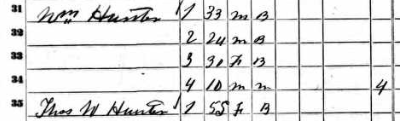
The Hunters were slavers. According to the 1860 Slave
Schedules they owned at
least 53 slaves. Thomas
Hunter (born 1821) listed his occupation as "Overseer"
in 1850 and "farmer" in
1860. He owned 39 people. Martha
Hunter (born 1790) owned 13. William
Hunter (born 1830) only owned 4 human beings. A disappointment to
the family, I’m sure.
Sadly, the Slave Schedules tell us next to nothing about the
victims themselves, the slaves. No names, no histories. The ages are
pretty horrifying though. 16 of Thos’ chattel slaves were fourteen
or younger. Do you suppose Thos waited for the little girls to reach
puberty before taking "his privilege" on them? Did he force
the 55 year old men to work in the fields? Wm’s slaves were 33, 24,
31, and 10. Martha had a 4 month old baby to call her own.
How many slaves do you suppose are buried in unmarked graves under
the suburban streets? I wonder what happened to them after
Emancipation. Something tells me they aren’t living in Pecan Grove
now.
Pecan Grove does have a Plantation Memorial Park. But
it’s not a memorial to the slaves who worked and died at the
plantation. It’s a memorial to military
veterans. Which is certainly fine (it’s not a Confederate
memorial), but one wonders why the word Plantation is on it. Pride in
their white heritage, no doubt.