Starlink is good technology. I’m posting this blog entry from space. By which
I mean Starlink, SpaceX’s new LEO satellite Internet service. I’ve
been beta testing it for six months and using it exclusively for two.
It is terrific. Some notes from a United States perspective.
Does it work well? Hell yeah! It’s more like having cable
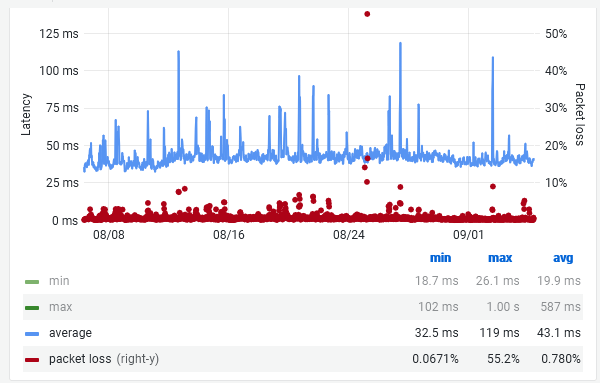
Internet than satellite. Over the last month my average bandwidth has
been 100Mbits/s down, 12Mb/s up. Average ping to 8.8.8.8 of 41ms with
0.5% packet loss. Bandwidth is highly variable (50-200Mbps) but
latency is pretty solidly 30-50ms. The main failure is occasional
outages of ~10 seconds. That got a lot better mid-July with a Starlink
change and will only get better as they launch more satellites. The service is
still technically beta and there are some rough patches but it’s
totally usable.
Is Starlink for you? Maybe. If you can get wired service (cable,
fiber, faster DSL) that is probably a better choice. If you’re in a
poorly served rural area in Ajit Pai’s America and you’re
struggling with ViaSat or Hughes or using cellular, definitely. For me
it’s an upgrade to my 12/1 Mbps fixed wireless service.
Will Starlink work at your house? Probably! It requires a clear
view to the north. The free Starlink mobile app has an augmented
reality tool to show you whether you have a good view. A few small
obstructions are OK but if you live in the middle of a bunch of trees
you need to go higher on your roof or get a mast.
Can you get it? Probably not soon. They are enormously
back-ordered; Starlink has a limited amount of bandwidth per satellite
and they are slow to add new users. They just passed 100,000 installs
globally and are rumored to have 500,000+
customers on the waiting list. The best thing you can do is
pre-order and put down a $99 deposit. It may be a year. (I got super
lucky.)
Is it nerd friendly? Totally. You can use your own router; Starlink
provides one but does not require it. Dishy has an open gRPC
interface for getting detailed stats. The Internet service is
quite solid and not messed with in any way I can tell. They sorta
support IPv6 already and promise more. The main drawback is that (at
least in IPv4) the service is cgNAT, you
really can’t run a server behind Starlink in any reasonable way. The
cgNAT is for good reason: they’re doing some very sophisticated
routing, your packets may be relayed through several base stations
hundreds of miles apart and it’s remarkable you have a stable
external IP address at all.
Will Starlink succeed as a business? That’s hard to say. The
program is still beta and currently has no bandwidth caps or
significant throttles. And it’s $99/month: a lot by US urban ISP
standards but competitive for rural areas. The problem is the
satellites can only handle so many users and it seems too early to
tell whether it works out to be profitable. Launching thousands of
satellites is expensive but SpaceX are experts at that. Also crappy
companies like ViaSat keep
suing to stop Starlink because they can’t compete. Amazon is
trying to make up for being years behind by trying
to get the FCC to harass Starlink. The legal attacks seem to be
failing so far in the US but you never know.
What’s next for Starlink? They launched their first full shell of
satellites earlier this year, then took a pause. They seem to be
fine-tuning algorithms and transceiver power settings right now. The
next major change is a plan to use laser links so satellites can route
packets directly (currently everything is relayed to the ground). It
seems like a very hard problem but they are serious about doing it;
ultimately Starlink might be better than wired service.
I’m not an Elon Musk fan but I have to say Starlink is amazing.
And audacious; I never would have believed it would work (remember
Iridium?). But it does work and it’s been a significant upgrade for
me, so thank you SpaceX. The hilarious thing is the whole idea of
Starlink apparently is about Mars; the project started as a way to
design networking infrastructure for a colony on a new planet. Oh and
then completely upended Earth’s ISP market as a sort of proof of
concept.